Showing posts with label VIDEO MARKETING. Show all posts

Sunday, 3 December 2017

Top 20 Smart Ways To Get More Subscribers on YouTube in 2017

Video content is leading the way in the content marketing scene (as of 2017). YouTube is currently the leading platform for video blogging (vlogging), video sharing, and video marketing. It is a free platform offered by Google, and many (including me) love it.
Facebook and Twitter have recently stepped into the video marketing game, but they still fall way short of having the kind of impact that YouTube has.
If you currently have a YouTube channel, you must be wondering how you can get more YouTube subscribers, and how you can increase the reach of your YouTube videos.
With over a billion unique YouTube visitors per month, there is a large potential audience for every uploaded video. Whether it’s a video of someone performing a prank or a video of a fashionista’s summerwear review, YouTube is the go-to platform for video consumption.
With a whole new lot of YouTube stars on the rise, it is definitely a platform to be considered by everyone looking for some online marketing and publicity.
YouTube is a great platform for bloggers to broaden their internet reach by making a personal connection with their followers.
The possibility for a blogger to leverage this social media giant and drive huge traffic from YouTube is high. To do that, one first needs to get more subscribers.
Note: This detailed guide to getting YouTube subscribers is long. Make sure you have enough time now to read it, or you can always bookmark it and read it later! 

20 Smart Ways To Get More YouTube Subscribers in 2017

Another year has gone by and your resolution to re-build that YouTube channel of yours has not been accomplished.
If you are thinking about revamping your YouTube channel, here are 20 smart ways to gain more YouTube subscribers in 2017.
I recently had the opportunity to attend a YouTube fan-fest with a VIP invitee (thanks to my wonderful acquaintances), and a little interaction with them will shed some light on how these things work out.
I have another associate (a student of mine) who saw a tremendous amount of growth in his YouTube subscribers and viewers within a span of two years. Although his numbers might not be outrageous, they total well above a million views, which more than justifies his efforts.
All that said, correctly implementing these techniques will surely help you achieve your goals.
1. Create a plan (and script) for your videos.
Drawing board
“He who fails to plan is planning to fail.“
– Sir Winston Churchill
The first step in getting started on your YouTube journey is to plan what your channel is going to be all about.
Then you need to plan the structure of the videos.
Decide what it is that you love creating and focus on developing related skills. Do not mimic trending YouTube channels. Doing what you love is more important for success on YouTube (and in life).
Videos tend to perform better if you write a script because scripts help you in organizing your videos efficiently and keeping you on track. By sticking to a script, you’ll be able to stay on track without veering off to an unrelated topic. This script will also ensure a perfect flow of events resulting in a well-focused video.
Include as many details as possible into your video script:
  • The exact words you are going to say.
  • The actions you will be taking in the video.
  • The main points you need to stress.
  • Any necessary calls to action (click on this link, subscribe to my channel, etc.)
Also, identify your target audience and write your script based off of their understanding.
Are they technically savvy? Are they non-native English speakers? Are they smart or dumb? What are their levels of expertise in relation to yours? Do they want something funny or informative?
Identify who your audience is and use appropriate language.
2. Produce highly engaging content (obviously).
quality-is-not-an-act-it-is-a-habit
It should go without saying, but you need to create content that is engaging, informative, and entertaining. Make sure it stays that way for the entire duration of the video. Losing the hook in the middle will cost you a lot of viewers.
Content that works the best is content that is either entertaining or informative. The content that really works the best is content that is entertaining AND informative. This is pretty standard with any kind of content marketing, but in particular, videos that inform and entertain are usually the most successful.
Specifically, you should be uploading a combination of burst and evergreen videos. Burst videos will be all the rage for a limited time, getting you instant hits, but will fade away as time passes by.
Evergreen videos are the ones that will get you archived views and will remain relevant irrespective of time. Ideally, if possible, you should try to create mostly evergreen content.
If you fear the wrath of the camera, you can try publishing ‘Screencasts‘. You can still make screencasts entertaining and informative.
Whatever you do, before you hit the publish button, make sure your videos are highly engaging and will be of value to your audience.
3. Increase your uploading frequency.

you-have-to-love-what-you-do-to-want-to-do-it-everyday
Now this is easier said than done, but you cannot ignore its validity. The main reason someone subscribes to a channel is because they love the work of the publisher and wants to see more of their videos.
YouTube subscribers usually do not like channels that don’t produce regular content. Especially in today’s digital age, consumers want continually more and more entertainment. You need to be able to keep up with your subscribers’ demands.
Consistency is the key to developing a long-lasting relationship with your subscribers.
Release your videos in a timely, recurring, and structured fashion. Try to publish one video per week… or at least one or two per month.
Stick to your schedule and do not upload videos off of this schedule. This will hurt your reputation. It’s like watching your favorite TV series; a new episode comes out according to a regular schedule. This consistency helps you stay engaged as a viewer.
4. Learn how to optimize your titles.
Being distinguishable is the most important aspect of YouTube success.
One great way to do this is to give your videos offbeat names. This way, you’re going to be getting a lot of people coming to your channel based on curiosity alone.
Having quirky titles will play a major role in getting the views that your channel needs to benefit from the social proof factor.
But to get a maximum amount of views, you will also need to dive into the SEO part of YouTube marketing.
Here are a few tips for optimizing your YouTube titles for greater reach:
  • Use the keyword in the title. This had a larger impact on SEO in the past, but it still has a pretty large effect on video. Google crawlers don’t watch videos the way they read blog posts, so putting the keyword in the title will let Google bots know what your video is all about.
  • Use Google Adwords to identify what people are searching for on the web. Try to tackle videos with a perfect blend of high volume searches and low competition.
  • Don’t make the title too long. Google truncates the length of the video down to 66 characters and adds ‘YouTube |’ before the video (taking an extra 10 characters). Your ideal video title should be no more than 50 characters.
  • Make the title descriptive. Give the audience a sneak peek as to what the video will be about.
  • Make the title engaging. Like I said above, having a quirky title will get more people to click. The more clicks you have, the higher it will rank.
  • Don’t use the word “video” in the title. This will only take up space and won’t help you rank higher on YouTube’s search engine (though it may have an effect on normal search engines).
5. Make the most of channel customizations.
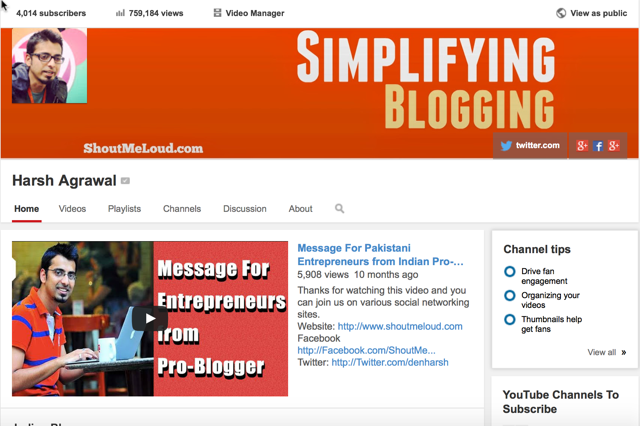
youtube channel customization
If you are going to get visitors to trust your brand on YouTube, you have to make the most of the customization options that YouTube has to offer.
Make yourself appear professional, and viewers will be sure to respect and trust you.
If you already run a blog with a bit of a following, make use of similar branding elements for your YouTube channel. This will make you easily recognizable across all platforms.
Having some well-crafted, custom channel art for YouTube will help you establish yourself as a brand. You can use this pretty cheap (Only $19) YouTube channel art service which lets you create your own optimized YouTube channel art.
Use a custom background header that includes some design elements from your blog.
Make the most of the YouTube channel bio and custom URL to finish up your channel customizations. Keep the bio short and to the point. You can always link to your blog’s URL in the video description for a more detailed bio.
6. Personalize video thumbnails.
Custom YouTube tumbnails
Here is something many YouTube creators agree upon.
Create a custom video thumbnail for each video instead of letting one be randomly generated. This only makes sense.
Using annotations and relevant images as custom thumbnails for your YouTube videos will increase your videos’ CTR (click through rate). A custom video thumbnail with a minor annotation will tell your users what your video is all about.
YouTube currently offers a selection of thumbnails from three intervals – at the 1/4th mark, at 1/2 mark, and at the 3/4th mark. Choose the one that best illustrates what your video is about.
7. Create an engagingautomatically play a video upon the opening of a YouTube channel.
Your channel trailer is something you must carefully work on and constantly improve to keep visitors engaged.
This is the moment where you need to catch your audience’s attention within a few seconds. The perfect channel trailer is somewhere between 30 seconds to 60 seconds.
Here you will need to provide a reason to your potential subscribers as to why they must stay on your channel, and what it is that you have to offer them.
If you are good in front of the camera, give a quick, informative, and engaging introduction(with a well-structured script).
In your YouTube’s Channel Reports, check the viewer retention rates to see if you are killing off potential subscribers with a boring or lengthy channel trailer.
Tweak it until it’s perfect.
8. Make use of ‘Call to Action’ annotations.
Call-to-action
‘Call to action’ annotations are those annoying popups in the video (which can be a blessing for the YouTube creators). If used in a proper way, you can get more subscribers by making your visitors click them during the video.
Many YouTubers have reported increased channel subscriptions with these annotations added to their videos.
A simple link created for subscribing to the channel can be placed as a call to action in your video.
If you’re using a graphic to add a call to action, you can liven it up with a call to action annotation.
If done in an unobtrusive way, you will see your channel subscriptions grow. 
But again, the key here is not to be annoying. Users will not subscribe if your only reason for making videos is to get more people to subscribe.
Do it smartly, and it will pay off.
9. Use the right tools.
There are a lot of great tools out there. From tools to help you make videos to tools to help you promote your videos, using the right tools will help you increase your organic viewership.
And the more organic views you have, the more potential subscribers you can get.
For me, I have been using TubeBuddy for a while & I highly recommend it to anyone who is serious about YouTube marketing.
  • Check out my TubeBuddy review.
TubeBuddy will help you find more viewers, make more money, and automate your entire YouTube process. Definitely check it out.

Saturday, 28 October 2017

Long Form Content SEO Ranking Strategy: 11 Must Follow Tips to Rank

Long Form Content SEO Ranking Strategy
Have you ever written a piece of long form content or eBook of 4000 words and above before?
If you haven’t, you probably don’t know the benefits and think that it’s just a lot of pointless work. But if you have, you already know that while it is indeed a lot of work, the result of that work can mean a great difference in search engine rankings. Earlier I wrote about two important things to make your long form content rank & many readers asked for more detailed guide on this and here we are.

Now, let’s say that you want to set up your own business. You lie awake every night terrified that your business might end up being a failure.
Then, one day, you see an A-Z guide for starting any business, and fortunately, this guide clears all your doubts and helps you to get started. This guide is loaded with all the information you need, and after devouring it, you begin to trust the people that created it.
So the next time you need to get anything for your business, like project management software, or advice on how to manage your work-life balance, you now have a trusted source to go to.
That is the benefit of creating informative, in-depth, long form content.
To put it succinctly, long form content will get you more of what you want from your blog – more visibility, improved engagement and social shares, more backlinks (which means higher ranking in SERPs), and most of all, it will make your audience start seeing you as the ultimate authority in your industry.
However, this post is not about the importance of long form content.
Instead, I’m here to share with you:

11 SEO Hacks For Creating & Ranking Long Form Content

1. Start With Keyword Research

Before writing your long form post, take the time to search for the best focus keywordon the topic, and also consider targeting a lower competition keyword.
Just ensure you carry out this step correctly because it will ultimately determine the success of your content in search engines.
There are many amazing tools on the internet that will make your keyword research task effortless.
Two of my favorites are:
Keyword-research-for-long-form-content
Check out this post of the best tools for keyword research.
If you still don’t know how to carry out effective keyword research, check out the tutorials below:
  1. A Comprehensive Guide To Keyword Research By Juggernaut Method
  2. Keyword Forensics: Taking Your Keyword Research to the Next Level
  3. The Importance of Keywords in SEO: A Beginner’s Guide
2. Target Long Tail Keywords
Now, you already know that you should have a focus keyword while writing your long form blog post. But what a lot of people don’t know is that they should be targetinglong tail keywords.
These are the type of keywords that get super specific on any topic. Long tail keywords are usually much easier to rank and drive in highly targeted traffic.
Below is an example of long tail keywords which I got from the popular keywordtool.iotool:
Target Long Tail Keywords
You can also use the same tool to gather as many long tail keywords as possible. But, if you’re having trouble coming up with more of such keywords, another good place to look at is the “related searches” section in Google:
Searches related to long form content
For more on long tail keywords, check out these guides:
  1. Why Long Tail Keywords Is More Important Than Exact Match Keywords
  2. 6 Awesome Tools to Find Long-Tail Keywords In Any Niche
  3. Free LSI Keyword Research Tool To Rank Higher In Searches
3. Optimize and Clean Your URL
It’s been confirmed that cleaner and shorter URLs help search engines better understand what your post is talking about, and they also provide a better user experience.
Also, you want to ensure your URL contains your target keyword; this will enable it to rank better.
Optimize and Clean Your URL
Short and concise is best.
Check out the guides below for a better understanding of URL structure:
  1. 15 SEO Best Practices for Structuring URLs
  2. 10 Useful Tips for Structuring URLs For Higher Ranking [Infographic]
4. Use A Proper H1 Tag
Your H1 tag will always be the first thing people see when they arrive at your blog posts.
Typically, your H1 tag is usually your blog post title.
Use A Proper H1 Tag
A good H1 tag can significantly impact your search engine ranking.
The chart below shows the search engine ranking result gotten from a local car parts store in Houston, Texas after they changed some of their page titles and H1 tags:
H1 tag impact search engine ranking
A well optimized H1 tag will enable the search engines to better index your content.
Ideally, your H1 tags should:
  • Be short and to the point.
  • Provide a clear idea of what the blog post is about.
  • Have a long tail keyword (your target keyword).
Once your headings have these qualities, you’re good to go.
For more on H1 tags and titles, check out:
  1. 7 Free Blog Post Title Generators & Analyzers for More Traffic
  2. 3 Easy To Use Tips for Writing Post Title For High Traffic
5. Add Good Subheadings
In an article posted on LinkedIn Pulse, Keren Lerner stated that “Your headlines may be catchy. Your writing may be amazing. You may have well-crafted words, punchy sentences, and incredible insight into the minds of your reader. But if your blog [post] is longer than 150 words, you need to add sub-headings – or build them in as you go!”
According to her, this is because, “big block of texts can feel like a chore to read.”
In case you don’t know, subheadings are the h2, h3, and h4 tags usually contained in a blog post.
Use subheadings to break up your content into easy to follow chunks. This will help your readers navigate and skim your content better.
For more on sub-headings, check out:
  1. Heading Tags SEO: Tips for Using H1 to H6 Right Way
6. Add Inbound Links
Internal/inbound links refer to any links from one page on a website that points to another page on the same site. It’s one of the methods smart bloggers and content marketers use to tell Google and website visitors that a particular page of content is relevant.
There are many benefits associated with internal linking, some of which include:
  • It helps to boost your ranking for certain keywords.
  • It helps search engines easily crawl your site.
  • It can help you to promote some paid services.
  • It gives your audience further reading options.
For more on internal linking:
  1. 3 Best Solutions For Blog Posts Interlinking in WordPress
  2. What Are The Top Benefits of Interlinking Your Blog Posts?
7. Add Outbound Links
Just like inbound links, linking out to related pages in your niche tells Google that your page is of higher quality; it also helps search engines figure out your exact topic.
According to Brian from Backlinko, “Not linking out might be the #1 on-page SEO mistake that I see people make. I try to use 2-4x outbound links per 1000 words. That’s a good rule of thumb for most sites.”
Brian's take
For more on outbound links:
  1. How Outbound Links Improve Your Blog Authority & Ranking
  2. How Effective Are Outbound Links?
8. Optimize Your Title Tag
Title tags are incredibly essential; a properly optimized title tag will drastically enhance your page’s visibility in SERPs. They’re usually the very first thing people see when your content shows up in the search results.
For the sake of clarity, a title tag is the title of each result that comes up.
Here’s an example:
Optimize Your Title Tag
While writing your page’s title tag, ensure it contains your focus keyword and also describes the benefits the page offers.
For more on optimizing title tags, check out:
  1. How To Use WordPress Post Permalink & Post Title Combination for SEO
  2. WordPress Tags – What You Are Doing Wrong & How To Fix It
9. Optimize Your Meta Description For SEO
A meta description is a 160 character snippet that summarizes a page’s content.
Optimize Your Meta Description For SEO
Just like the title tag, your page’s meta description will enable your post to stand out in the search engine result pages.
A properly optimized meta description should:
  • Include a focus keyword.
  • Be brief (about 160 characters).
  • Be crystal clear and descriptive.
  • Contain a call-to-action (CTA).
  • Be enchanting and entice the visitor to read the entire page.
For more on optimizing meta descriptions, check out:
  1. How To Write Meta Descriptions For SEO (with good and bad examples)
  2. How To Create The Right Meta Description
10. Include Multimedia
You already know that content marketing is not about just text. Text alone can only take you so far. Entertaining videos, images, screenshots, diagram, and charts can take you a lot further.
They will:
  • Boost the time spent on your site.
  • Reduce your bounce rate.
These are the two important user-interaction ranking factors that Google has been using to judge web pages recently.
You must have noticed that I often use a lot of images, charts, and screenshots on my blog posts; this is simply because I know the benefits they add to my content. Apart from boosting time on site and reducing bounce rate, they will also enhance the perceived value of the page, which will equally increase the likelihood of people linking to it.
Therefore, while writing your long form content, try and add as many relevant multimedia as possible.
For more on enhancing your page with multimedia, take a look at:
  1. How To Embed YouTube Videos in WordPress
  2. 20 Awesome Tools for Creating Engaging Visuals for Your Blog & Social Media
  3. 10 Absolutely Free Websites to Download Stock Images
11. Add Your Target Keyword And Related Keywords
It is important to include your focus keyword in the body of your blog post. However, you should not overdo things – just ensure it’s in there a few times.
This will make Google understand that your focus keyword is important while crawling your content.
Also, sprinkle in some related, low competition keywords throughout the content to enable you rank for even more focused long tail keywords.
Finally, it’s also advisable to mention your keyword toward the last paragraph of your article, and also in some of your subheadings. However, always remember to tread with caution and don’t over do it.
For more on adding in keywords, check out:
  1. What Is The Optimum Keyword Density for Better Ranking?
  2. Shattering The Myth About The Keyword Density Formula

Performing Proper SEO Of Long Form Content

Long form content is truly effective in positioning you as an authority on your topic, and also effective for enhancing your search engine ranking. However, this can only be achieved with solid SEO practices – like these 11 points.
Remember that this is not a complete list of everything needed to have a great SEO. These are merely the basics that will help you craft the best long form content on any topic.
Like you already know, search engine optimization is a long term strategy and not something you should expect seeing results in immediately.
In order for it to really have the best effect possible, you need patience.
Implement these techniques, and then watch, with patience, as your rankings skyrocket.
Do you have any more SEO ranking tips for long form content you’d like to share with us? Which one of these ranking tips do you often forget to implement? Share your thoughts with us in the comments below!
Like this post? Share it with your friends!